| Jan
Young's Logistics Catalog |
| Title |
Length
|
Price
|
| Cycle
Count and Physical Inventory Design and Execution |
44
Pages
521
Kb |
Digital
$9.95 Print
$18.95 |
|
 This engineering guide is intended as an
introduction to both kinds of inventory counting for senior management and
process engineers in the logistics, distribution and warehousing
industries. This engineering guide is intended as an
introduction to both kinds of inventory counting for senior management and
process engineers in the logistics, distribution and warehousing
industries.
It explains
what can and what cannot be accomplished with a program of cycle counting.
It describes how cycle counting should be structured and how it
should fit into the organization. It
reviews the math required to determine the optimum level of cycle counting
and lays out a sample cycle counting program that includes the training
required, both for the workers who actually perform the counts and for the
supervisors who direct them and use the results.
It
also discusses the reasons why full physical inventories may be necessary,
the problems associated with accuracy, and the circumstances under which
they can be eliminated. It
reviews inventory-taking processes and discusses training and auditing
requirements and can serve as a guide for the auditors and supervisors who
specify and control the process.
Click
here for a synopsis. Click
here to order
online as a printed book. Click
here
to order online as a downloaded pdf file. |
| Best
Practices in Replenishment of Forward Pick Locations |
35
Pages
320
Kb
|
Digital
$9.95
Print
$14.95 |
|
 This executive briefing reviews the theory of replenishment. It discusses when items should be replenished
and when they should be picked directly from reserve stock.
It further discusses the handling and management of multiple
reserve locations and of multiple forward locations.
The use of cascading replenishment and the practice of using replenishment
facilities to manage items with highly-variable demand are both covered. The result
is a comprehensive review of the replenishment function that has the
potential of both simplifying your operation and, at the same time,
improving productivity. This executive briefing reviews the theory of replenishment. It discusses when items should be replenished
and when they should be picked directly from reserve stock.
It further discusses the handling and management of multiple
reserve locations and of multiple forward locations.
The use of cascading replenishment and the practice of using replenishment
facilities to manage items with highly-variable demand are both covered. The result
is a comprehensive review of the replenishment function that has the
potential of both simplifying your operation and, at the same time,
improving productivity.
Click
here for a synopsis. Click
here to order as a
printed book. Click
here
to order as a downloaded pdf file. |
|
Selecting,
Buying, Installing and Using a Modern Warehouse Management System |
142
Pages
1012
Kb |
Print
$22.95
Digital
$9.95
|
|
 This
briefing is written for the executive who is considering the installation
of a warehouse management system in a currently un-automated supply chain.
It contains, however, a significant amount of information of value
to those who have been through the process and are now in maintenance and
operation mode and may have special value to those who are dissatisfied
with their present system and are considering a replacement. This
briefing is written for the executive who is considering the installation
of a warehouse management system in a currently un-automated supply chain.
It contains, however, a significant amount of information of value
to those who have been through the process and are now in maintenance and
operation mode and may have special value to those who are dissatisfied
with their present system and are considering a replacement.
The remarks
included in this briefing apply equally well whether you outsource all or
part your supply chain, or whether you perform all functions internally.
Unless you have contracted with a 3PL for use of its warehouse
management system, the issues faced, the processes required, and the costs
and benefits are identical. There
are, of course, benefits to the 3PL of having a single system for all of
its customers, but there are also benefits within a company of having a
single system for all of its 3PLs.
We begin with the purpose
of warehouse management systems and a description of their costs and
benefits. The build-versus-buy choice is discussed.
Organizational impact and the short and long-term effect on your customers
are described. The briefing then moves into a detailed description
of how to buy a WMS. This description covers the project team that
must be assembled, the marketplace for commercial systems, the types of
systems available and how you should go about choosing among them, the
creation of a Request for Proposal and the evaluation of RFP responses.
It also provides a methodology for justifying/funding a warehouse
management system and concludes with discussions of system installation
and maintenance.
Click
here for a synopsis.
Click
here to order as a
printed book. Click
here
to order as a downloaded pdf file. |
| Simulation in the Supply
Chain |
35
Pages
372
Kb
|
Digital
$9.95
Print
$14.95
|
|
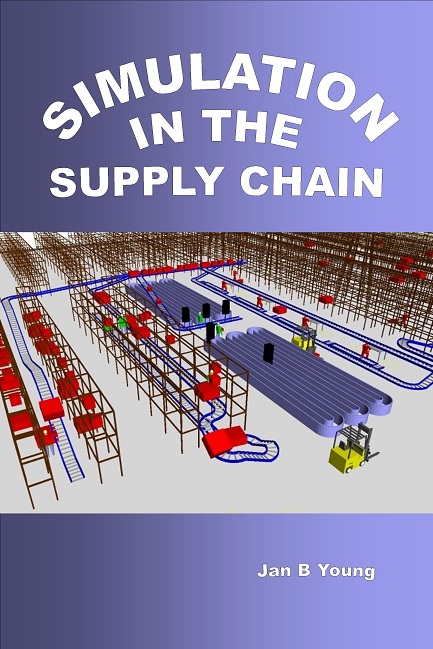 This executive briefing is an introduction to the technology of computer simulation for
middle and senior management in the logistics, distribution and warehousing
industries. It outlines
capabilities and potentials at several levels and may also be of use to
sales and marketing personnel. This executive briefing is an introduction to the technology of computer simulation for
middle and senior management in the logistics, distribution and warehousing
industries. It outlines
capabilities and potentials at several levels and may also be of use to
sales and marketing personnel.
Simulation technology is defined and
explained. Hardware and
software requirements are reviewed and a brief history of simulation is presented along
with examples of past successful use. Then, with reference
to the supply chain and the warehousing industry, possible uses of
simulation are detailed in several modalities (purposes) and at several
levels.
The benefits of
simulation as an analytical tool are reviewed, followed by a section that
describes industrial lessons learned from failed simulation projects and
the requirements for success that emerge from those lessons.
The briefing concludes with a short foray into the possible
future of the technology.
Click
here for a synopsis.
Click
here to order as a
printed book.
Click
here
to order as a downloaded pdf file. |
| Choosing
and Using a Consultant |
44
Pages
314
Kb |
Digital
$9.95
Print
$14.95 |
|
 Ever used a consultant?
Ever had a problem with a consultant? This executive briefing outlines tested and proven best
practices in the selection of consultants and in the management of
relationships with them. Ever used a consultant?
Ever had a problem with a consultant? This executive briefing outlines tested and proven best
practices in the selection of consultants and in the management of
relationships with them.
Although there are risks, the risk of engaging a
properly managed consultant is probably lower than the risk of hiring a
new employee.
Choosing and Using a
Consultant
is intended for senior and middle management. It
includes a model consulting contract and a model statement of ethics.
Click
here for a synopsis.
Click
here to order as a
printed book.
Click
here
to order as a downloaded pdf file. |
| Supply Chain
Metrics |
67
Pages
383
Kb |
Digital
$9.95
Print
$17.95 |
|
 The problem is, what to
measure? How can the value of a measurement be balanced against the
cost of performing it? How
can the needs of different organizations needing similar measures of the
same thing be reconciled and their needs met efficiently? What issues are
there in implementation? How
can redundant measures be simplified? The problem is, what to
measure? How can the value of a measurement be balanced against the
cost of performing it? How
can the needs of different organizations needing similar measures of the
same thing be reconciled and their needs met efficiently? What issues are
there in implementation? How
can redundant measures be simplified?
This executive
briefing discusses these questions and outlines a catalog of more than
eighty measurements for consideration.
Some of the cataloged measurements are common, some are
industry-specific, and some have unique and special purposes. Each
measurement is discussed in terms of its usefulness and application.
Implementation difficulties are reviewed and the executive is cautioned
where inaccuracies may result from assumptions made by implementers.
A review of the list may suggest metrics that should be considered for
implementation, may help users avoid the GIGO syndrome, and may reduce
business complexity by pointing out duplication in existing work. Click
here for a synopsis. Click
here to order as a
printed book. Click
here
to order as a downloaded pdf file. |
|
E-Mail
Us
|